Biomass productivity potential
Green algae can yield 100 tons/acre/year (or 65 gDW/m2/day yearly average), which is 16-fold higher than corn, assuming a solar irradiance of 5.3 kWh/m2/day and a 70% overall efficiency. This potential remains to be demonstrated, as current outodoor cultivation conditions waste absorbed photons as heat (non-photochemical quenching). As a result, algal biomass productivity remains low, on the order of 15 tons/acre/year.
Low photon flux per cell
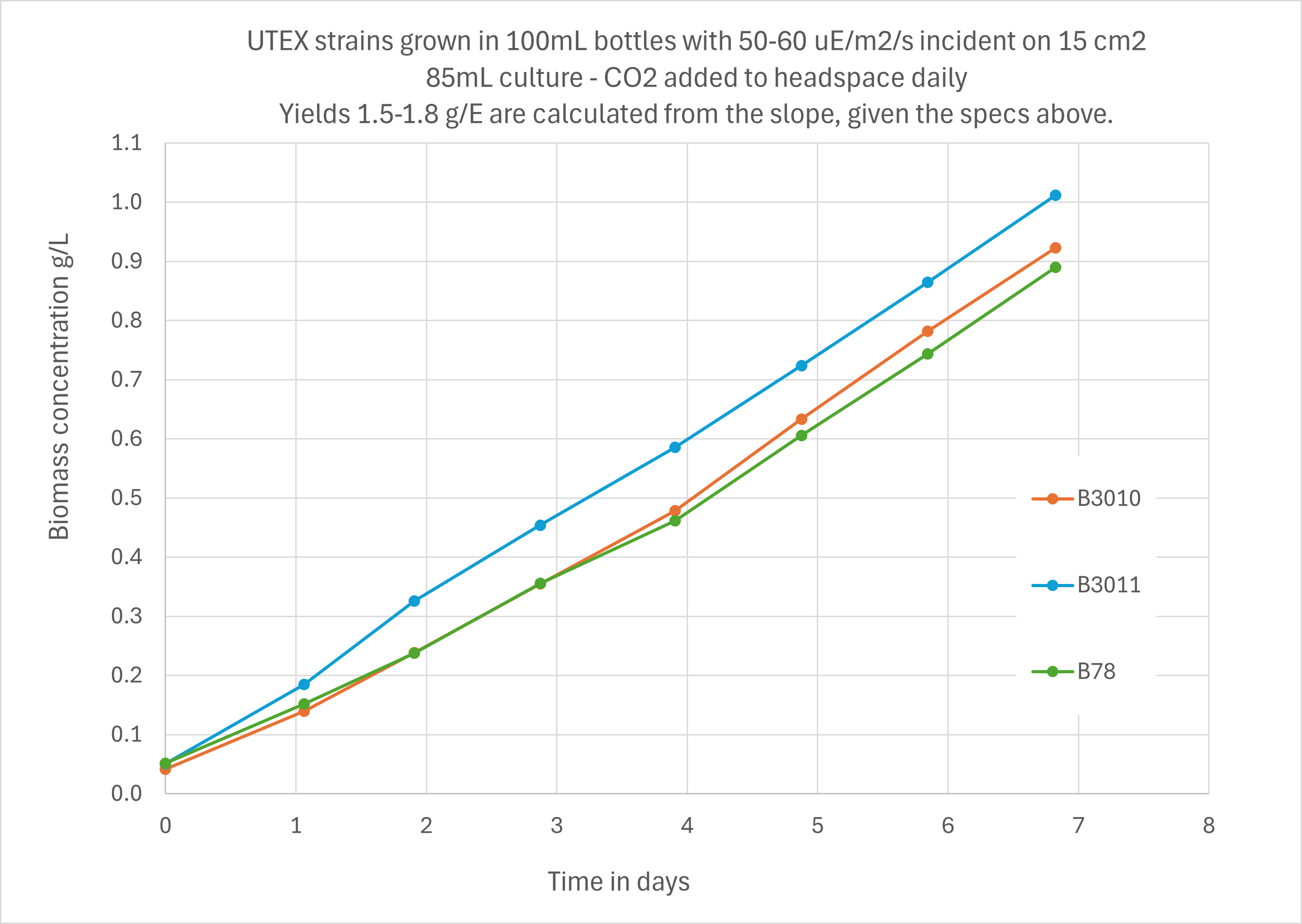
Under low light, high biomass density and nutrient-replete conditions, algal growth is linear. Namely, under low photon flux per cell, the quantum yield remains elevated, such that the resulting biomass productivity P is proportional to the flux of incident photons I0:
P = ΦDW·I0
The maximum theoretical biomass yield ΦDW is 2.5 gDW/E, where the Einstein E denotes one mole photons in the photosynthetically active region of the light spectrum.
PIARCS’ approach
PIARCS’s proprietary photobioreactor design aims to maintain the algae in a dark-adapted state (ensuring a high quantum yield) under high outdoor irradiance, aiming to reach 70% of the maximum theoretical biomass yield.
Publications
Holland AD, Dragavon JM and DC Sigee. Methods for Estimating Intrinsic Autotrophic Biomass Yield and Productivity in Algae: Emphasis on Experimental Methods for Strain Selection. Biotechnology Journal. 2011 6:572-583. https://doi.org/10.1002/biot.201000260
Holland AD and D Wheeler. Methods for Estimating Intrinsic Autotrophic Biomass Yield and Productivity in Algae: Modeling Spectrum and Mixing-Rate Dependence. Biotechnology Journal. 2011 6:584-599. https://doi.org/10.1002/biot.201000261
Holland AD., Dragavon JM. (2014) Algal Reactor Design Based on Comprehensive Modeling of Light and Mixing. In: Bajpai R., Prokop A., Zappi M. (eds) Algal Biorefineries. Springer, Dordrecht. https://doi.org/10.1007/978-94-007-7494-0_2